
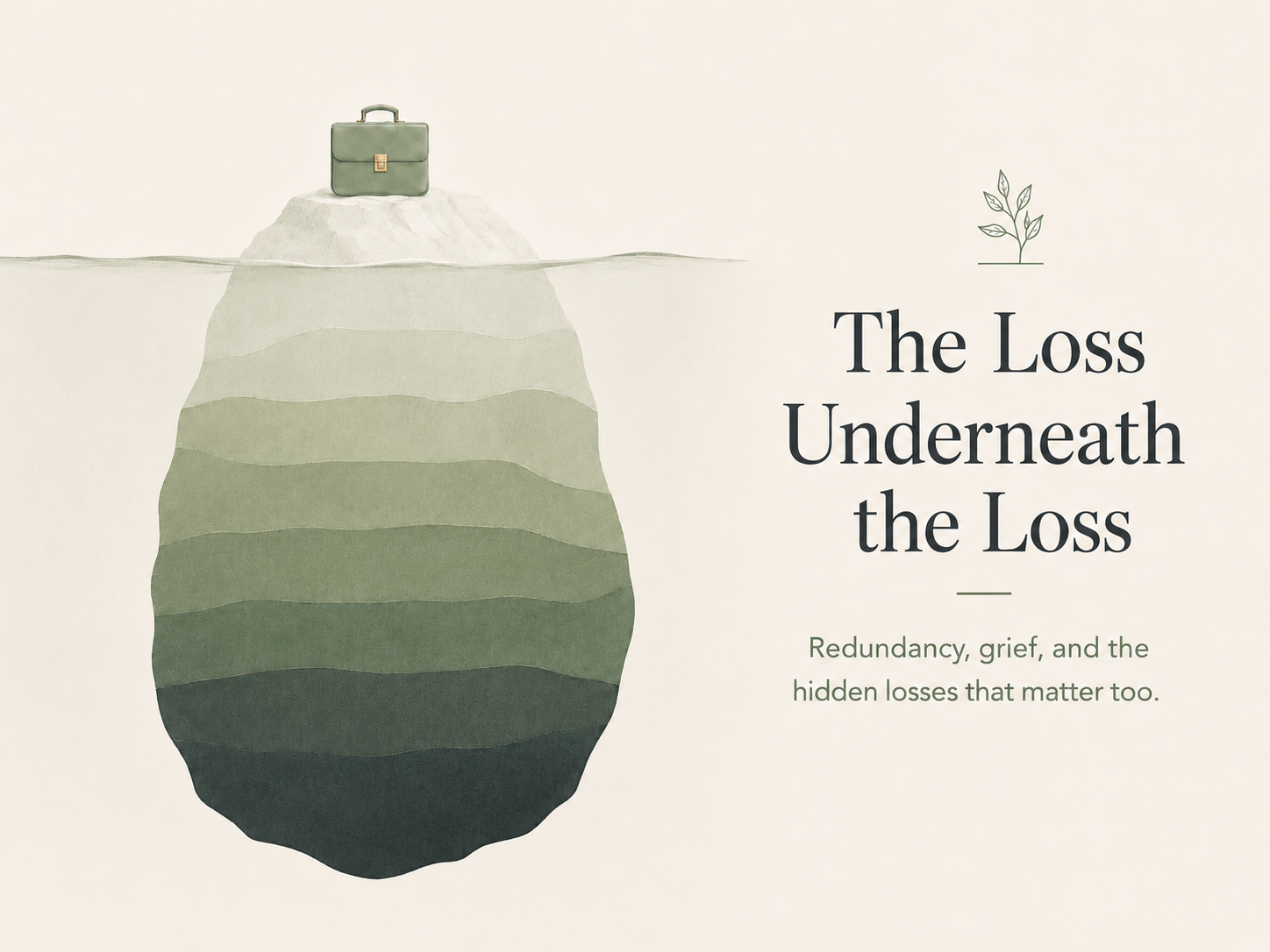
This article is inspired by David Kessler, one of the leading grief educators, and a newsletter I recently received from him.
In the newsletter, he described some of the losses he experienced after losing his son. There was, of course, the overwhelming loss of his child. But underneath that loss, there were many other losses too.
- Invitations from other parents stopped coming.
- Invitations to events that he used to attend with his son stopped as well.
- Parents who used to call and invite them to different games or activities no longer did so.
These changes may have appeared small to other people, especially in comparison with the primary loss. But they were losses too.
They were part of what David Kessler describes as the loss underneath the loss.
I’m working at the moment with two clients who have recently been made redundant. A third client is currently going through a consultation process and will most likely be made redundant within the next few weeks.
Each of them is trying to process the situation and the emotions they are experiencing.
For some people, when they lose their job, the primary loss is the job itself. It is the loss of income and employment.
But underneath losing the job, they may also be losing a role that held a big part of their life.
They may be losing a part of their identity and their understanding of who they are. They may be losing their sense of security. Redundancy can create the realisation that things can happen very quickly and unexpectedly.
Even when we work hard, perform well and believe that our position is secure, circumstances can suddenly change. Afterwards, it can be difficult to feel safe about the future.
There are also many smaller losses that may not be immediately visible.
- Looking at other people going to work while you no longer have somewhere to go.
- The morning coffee with a colleague.
- The office gossip.
- The familiar routine of getting ready and starting the working day.
- The colleagues you used to see during regular weekly meetings.
- The conversations in the kitchen or messages exchanged throughout the day.
- The sense of being needed, included and part of something.
When a person is made redundant, these everyday moments can disappear almost overnight. People they used to speak to every day may gradually stop calling. The regular meetings continue, but without them. The company moves forward while they are left trying to understand what has happened.
These are losses too. And they matter too.
Sometimes, people feel that they should simply move on and start applying for another job. They may hear comments such as, “You will find something else,” or, “Maybe this will turn out to be a good opportunity,“ or “It happens for the reason”.
These words are often well- intended. And perhaps, with time, a new opportunity will come.
But before a person can fully focus on what comes next, they may need space to recognise what they have lost. Not only the job.
The role.
The identity connected to it.
The relationships.
The routines.
The confidence.
The plans they had made.
And the feeling of security they once had.
Recognising the loss underneath the loss does not mean staying stuck in the past. It means allowing ourselves to understand why the experience may feel so painful and unsettling.
Redundancy is not only a professional event. It can be a deeply personal experience.
Sometimes, moving forward begins when we stop dismissing the smaller losses and give ourselves permission to acknowledge that they matter too.