
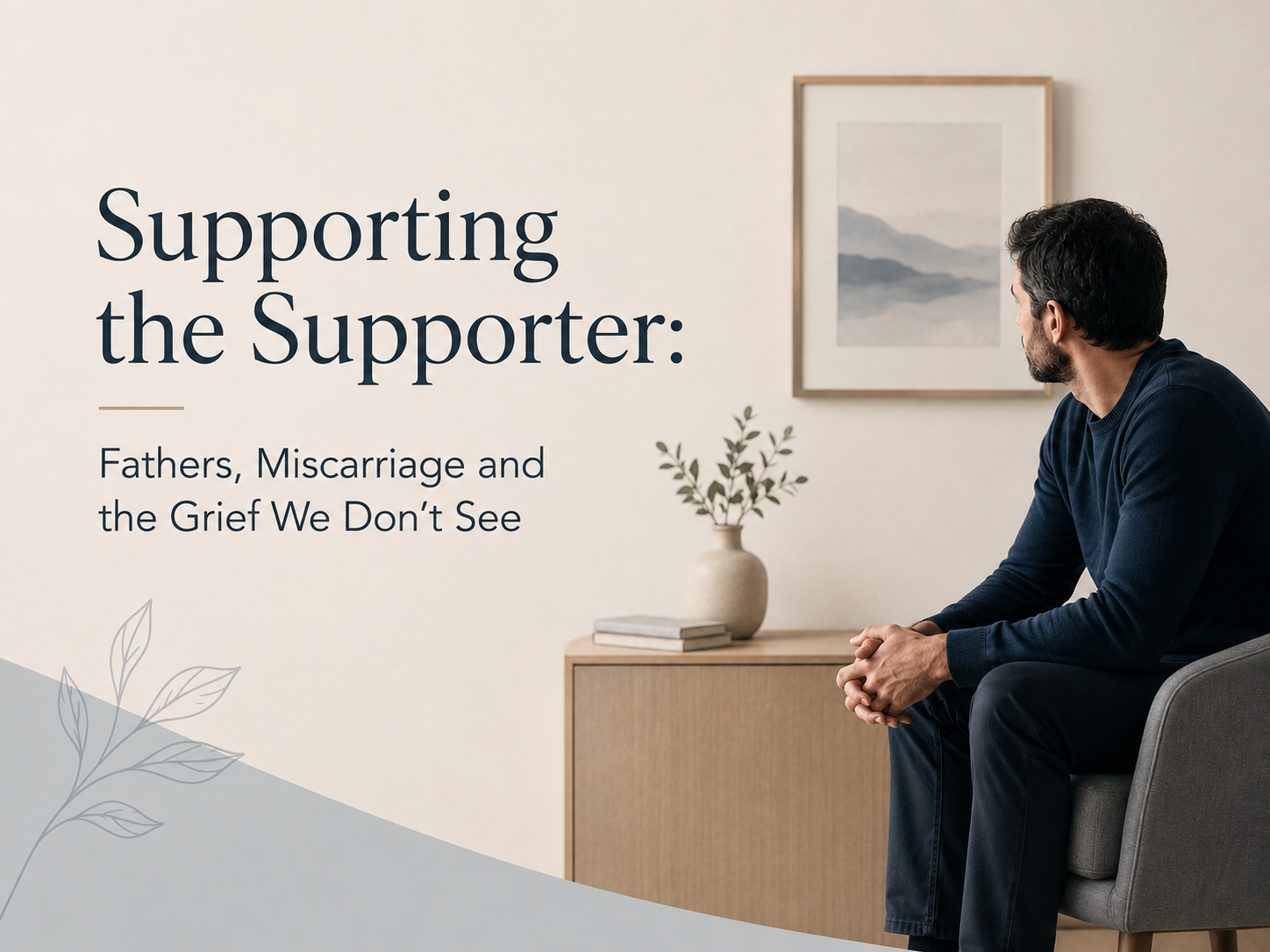
When we talk about miscarriage, pregnancy loss or infertility, most of the emotional support is focused on women. And in many ways, that makes sense, as the women carry the physical experience. Their bodies go through the loss, the procedures, the hormones, the pain and the recovery. Their emotional toll is also well documented in the past years. Research shows that miscarriage and infertility can bring grief, anxiety, stress, depression and a deep impact on overall health and wellbeing.
But there is another part of the story that I believe we still do not speak about enough.
The fathers.
The men who also imagined the baby.
The men who also built hope.
The men who also lost something.
The men who are often expected to support, but not to grieve.
For many men, social systems and expectations define their role from an early age: be strong, protect your partner, hold everything together, and do not fall apart.
And because of that, their own grief can become invisible.
Many fathers are not given the same attention in the process. They may sit in hospital rooms, attend appointments, hear difficult news, and still feel like they are standing on the outside. Not always ignored intentionally, but often not fully included either.
They may not be asked, “How are you coping?”
They may not be offered support.
They may not even feel they have the right to ask for it.
After miscarriage, many parents describe a deep sense of grief mixed with loneliness. It can feel even more painful because the loss is often not recognised in the same way as other deaths. There may be no funeral, no memories shared, no public space to grieve, and no clear permission to be heartbroken.
For men, this can be even more complicated.
Many internalise their emotions. Some cope through silence, distraction, work, or avoidance. Not because they do not care, but because they may not know what else to do. Some men focus only on supporting their partner, while pushing their own pain to the side.
What is striking is that many men do not even mention support for themselves. Their first response is often about how to support their partner.
But over time, especially after repeated losses, it can become harder and harder to keep carrying that role alone. Because the supporter also needs support. This is not about taking attention away from women. It is about widening the circle of care.
It is about understanding that miscarriage and infertility affect both people in different ways. It is about recognising that fathers may grieve differently, but that does not mean they grieve less.
Some men may need practical information.Some may need emotional space. Some may need someone to say, “This is your loss too.” Some may need support that understands the tension between wanting to protect their partner and needing to be supported themselves.
We need more father-inclusive care.
Healthcare professionals, family members, friends and workplaces can all play a part. Sometimes it starts with one simple question:
“How are you doing with all of this?”
Because fathers should not have to disappear inside their role as supporters. They can be strong and still be grieving.They can care for their partner and still need care themselves.
Their grief matters too.
Source:
BMC Public Health, The quality of life of men experiencing infertility: a systematic review, 2024
Men’s experience of miscarriage — UK qualitative study, 2022
Men after recurrent miscarriage — Irish qualitative study, 2022
Emotional wellbeing after miscarriage in hospital settings — scoping review, 2022
Men, grief and support after pregnancy loss/neonatal death — 2021 study
Social messages men receive after miscarriage — 2021/2023 study